
Design, disability and how we evaluate
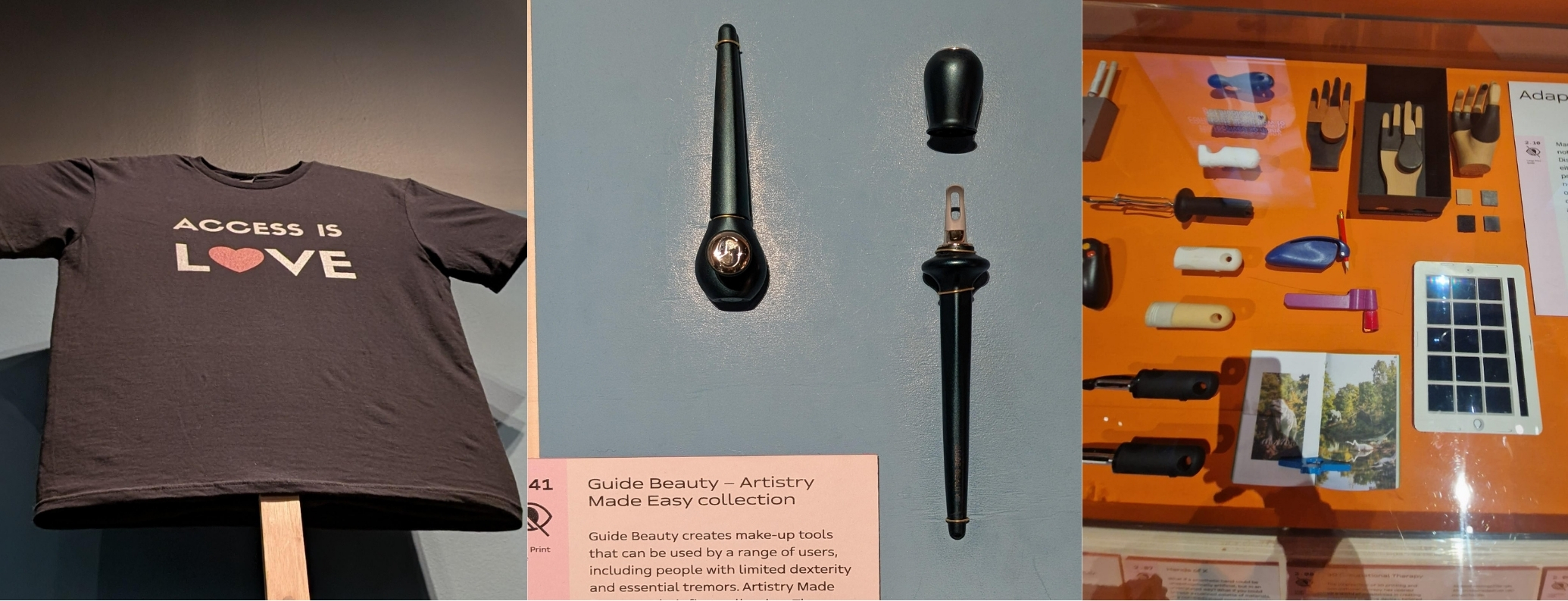
Last month, we visited the Design and Disability exhibition at the V&A—a space filled with objects, stories, and innovations created through, by, and for disabled, deaf and neurodivergent people and communities. The experience has left a lasting impression and prompted a deeper reflection on our own practice as evaluators. Crucially, it reinforced the importance of striving to make our work accessible, inclusive, innovative, and meaningful.
If there was one message that echoed throughout the exhibition, it was this:
“Nothing about us without us.”
A phrase rooted in disability rights movements, but one that applies powerfully to research and evaluation.

Rethinking accessibility in evaluation
The exhibition highlighted how design—at its best—strips things back to what’s essential. Rather than adding layers of complexity or defaulting to high-tech solutions, many of the most powerful exhibits were those that embraced simplicity. For example, the make-up tools for people with limited dexterity, and the button hook that made it easier for people with no or limited hand mobility to button and unbutton clothes. Thoughtfully designed objects that honoured users’ lived experience, not the designer’s assumptions.
Seeing these exhibits led us to ask ourselves:
- Are our evaluation processes as accessible as they could be?
- Do our questions invite participation, or inadvertently close it down?
- How might our tools, methods, and dissemination approaches become more inclusive by design?
Accessibility is not an add‑on. It is not a final check‑box before publishing a report. It is a thread that must run from the very start—shaping the evaluation questions we ask, the methods we choose, and the way we share findings. This was a powerful reminder of the importance of embracing human-centred design when it comes to designing and delivering research and evaluation projects.
Involving people who stand to benefit
One of the most striking parts of the exhibition was the prominence of disabled designers themselves*. Their perspectives weren’t just included—they were central. The creative work didn’t simply “represent” disability; it emerged from lived experience.
This resonates strongly with good research and evaluation practice: Involve the people who stand to benefit as early as possible.
Not as consultees.
Not as a late-stage validation panel.
But as co‑designers of the questions, the methods, and the meaning.
Too often, research and evaluation risks being something done to people rather than with them. Putting lived experience at the heart strengthens everything: relevance, credibility, ethics, and impact. This reaffirmed our commitment to collaboration and the use of participatory approaches in our research and evaluative practice. Also the importance of engaging widely. We’ve seen in previous work, including our own – exploring how public and patient involvement in health research is measured- the dangers of involvement being tokenistic, with too few stakeholders, that fail to represent the diversity of lived experience and those that stand to benefit. As Tristram Hunt, Director of the V&A sets out in the foreward of the accompanying exhibition book Design and Disability;
“The design process itself must be as diverse as the communities it serves”
Tristram Hunt , Director V&A
This feels particularly relevant in light of the emerging use of Artificial Intelligence (AI) and synthetic data to understand human behaviour. How can these technologies open more possibilities (not less) for meaningful involvement of people with lived experience? And is there a danger that such tools, used in isolation, will fail to account for individual experiences and those of more marginalised groups? These are important questions we are currently exploring in how we apply tools, such as AI, responsibly and purposefully to our own practice.
Simplicity as innovation
So often complex methodological frameworks or sophisticated analytical tools are presented as shiny new exemplars of innovation and best practice. Of course they have their place. But the exhibition was a powerful reminder that innovation doesn’t always mean high-tech.
Sometimes, innovation is:
- using clearer language,
- creating more flexible ways to participate,
- offering different formats for sharing feedback,
- or structuring our findings in ways that genuinely support understanding and action.
Simplicity done well is a form of excellence.
Towards more inclusive evaluation practice
Leaving the V&A, we were inspired to take a fresh look at our evaluation work and consider:
- How can we embed accessibility from question-setting to dissemination?
- Where can we strip away unnecessary complication whilst acknowledging the complex with clarity and simplicity?
- Are we involving people with lived experience early enough—and meaningfully enough?
- How can we make our findings usable for everyone, not just expert audiences?
These questions are not just about improving research and evaluation processes—they’re about shifting power, strengthening relationships, and ensuring the work we do genuinely benefits those it aims to serve. We’re not saying we always have the answers or that we’re perfect, but we can promise to do the best we can to move towards more inclusive, participatory approaches. We’re excited to share in the future what we are doing.
Becky Scott, Kay Lakin, Caroline Larsson
*We use the term disabled designers here reflecting the language used in the exhibition which sought to showcase how disabled people have always been, and continue to be, essential contributors to design and cultural production.

Learn more about Hatch
At Hatch we use our expertise and extensive network of researchers and partners to access the best minds and the latest thinking to drive meaningful change.
